AMD and Meta: What the Next Earnings Report Needs to Show
Source cutoff: November 2, 2026 (Korea Standard Time), before AMD’s Q3 2026 earnings release. English edition prepared November 3. Insights · Companies and industries
Key takeaway: AMD’s announcement that initial Helios systems are installed and being tested at Meta shows progress in execution. The existing purchase commitment for the first 1 GW, the partnership covering up to 6 GW, the latest system tests and AMD’s equity investment in Meta each require a separate assessment. The next evidence to examine is shipments, revenue recognition, profitability and cash collection.[1][2][3]
Start with the official documents: AMD’s October 27 partnership update · February 24 filing on the initial 1 GW purchase commitment and warrant · Next earnings release schedule
The biggest customer names and infrastructure figures tend to dominate AI chip partnership news. Investors have a more specific question to answer: how far has execution progressed, and when and to what extent will it contribute to AMD’s earnings and cash?
The latest AMD–Meta announcement offers a useful example. Bringing technology into a customer’s operating environment is a meaningful development. Product sales, an investment in the customer and stock purchase rights granted to that customer also sit within this relationship. Following the direction of the money and the rights helps explain each transaction.
1. What the installation and testing of Helios changes
[Fact] On October 27, AMD said initial Helios rack-scale systems were installed and being tested by Meta, with broader deployment planned. The announcement also described existing production use of Instinct GPUs for workloads including training and recommendation. That existing Instinct use should be distinguished from testing the new Helios systems.[1]
Helios brings multiple computing components together at rack scale. GPUs, CPUs, networking and software must work together in the customer’s environment. Installation and testing can therefore be interpreted as progress in validating system integration and operational suitability.
[Interpretation] The change is that execution is being tested at the customer’s site. Initial testing and large commercial deployments can involve different scales. The announcement does not disclose a purchase amount or a quarterly revenue recognition schedule for the systems being tested.[1]
When reading an installation update, it helps to ask both whether performance and operations are being validated and what scale of revenue has resulted. Those questions are related, but the evidence needed to answer them is different.
2. The first 1 GW commitment and the partnership covering up to 6 GW
[Fact] AMD and Meta had already announced a multiyear partnership covering up to 6 GW on February 24. Shipments supporting the first 1 GW deployment were expected to begin in the second half of 2026. GW measures power capacity and cannot be converted directly into a dollar amount of revenue.[2]
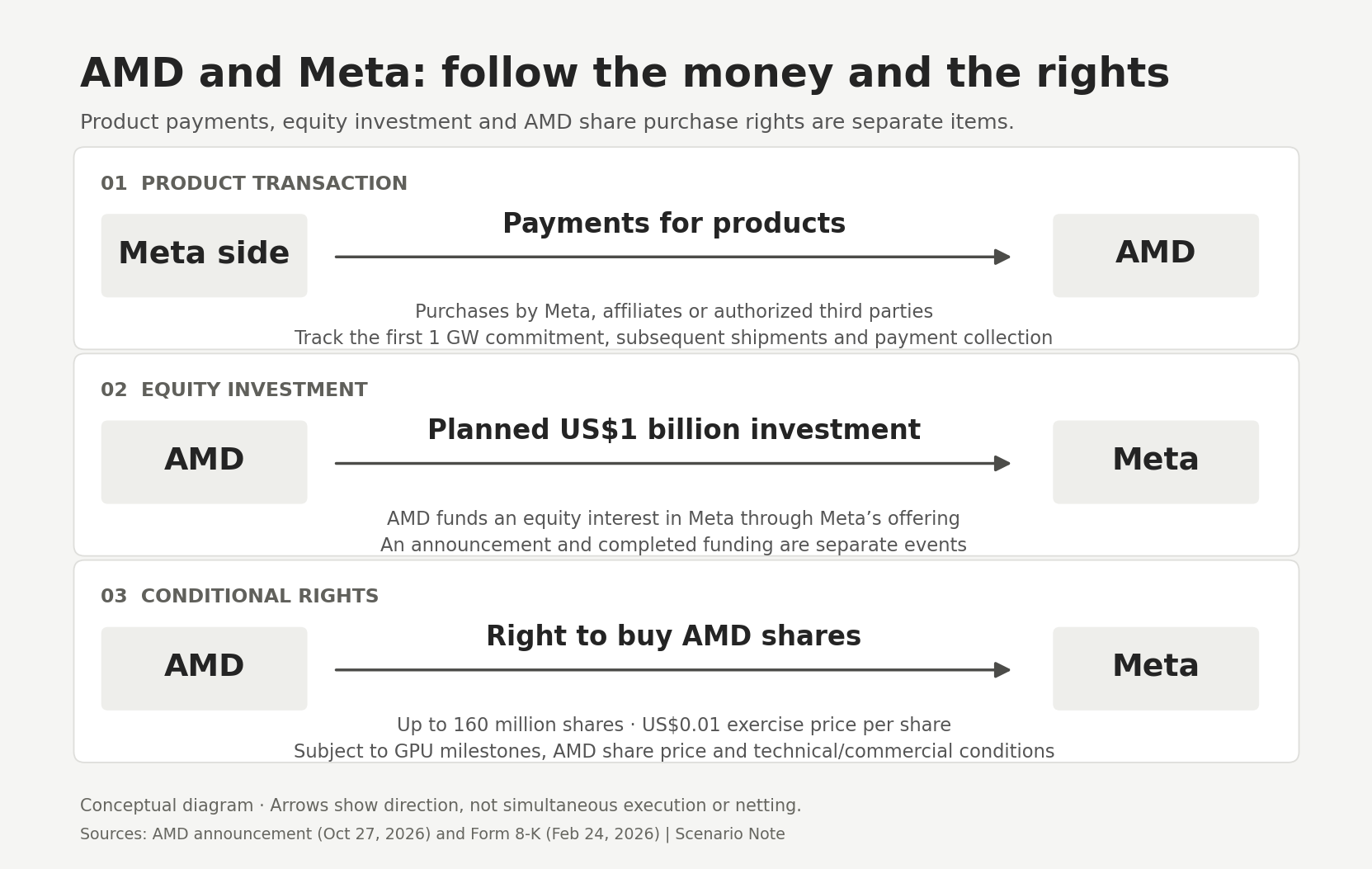
The Form 8-K disclosed on the same date provides a more specific detail. Meta agreed to a binding commitment to purchase the initial 1 GW equivalent of certain AMD Instinct GPU products, directly, through affiliates or indirectly through authorized third parties.[3]
| Item | What the official documents establish | How to read it alongside earnings |
|---|---|---|
| Initial 1 GW | A binding purchase commitment for certain Instinct GPU products | This establishes a contractual commitment. Actual shipment and revenue recognition timing still require confirmation. |
| Up to 6 GW | The scope of a multiyear partnership across product generations | Separate the initial commitment from further expansion. The full scope cannot immediately be treated as recognized revenue. |
| Initial Helios installation and testing | Progress at the customer’s site reported on October 27 | This helps assess execution of the earlier plan. It does not by itself establish that the entire first 1 GW has shipped. |
[Interpretation] Execution should be assessed against an already disclosed purchase commitment. There is also no basis to conclude that the full potential scale has been committed on identical terms or recognized as revenue. The October update shows installation and testing progress within the existing partnership.
3. The $1 billion investment and the direction of the stock purchase rights
[Fact] AMD said in its October announcement that it would invest $1 billion in Meta’s equity offering. The direction is AMD providing funds to acquire an equity interest in Meta. An investment announcement and completed funding are separate events.[1]
Separately, the February filing states that AMD granted Meta a conditional right—a warrant—to buy up to 160 million AMD shares at an exercise price of $0.01 per share. GPU purchase and shipment milestones and AMD share price thresholds apply, along with technical and commercial conditions before exercise.[3]
A warrant is a right to acquire shares if its conditions are met. It does not mean the recipient already owns the full number of underlying shares. AMD’s Q2 Form 10-Q states that as of June 27, no tranches of the warrants granted to OpenAI and Meta had vested or become exercisable. That statement applies to that date; subsequent status requires later disclosure.[4]
[Interpretation] Product sales call for an assessment of revenue, profit and payment collection. The investment in Meta calls for an assessment of investment terms, funding timing and the value of the acquired asset. The warrant calls for an assessment of conditions, accounting effects and potential dilution for existing shareholders. Their economic meanings differ even within the same partnership.
Subtracting the announced investment from future product sales to invent a “net revenue” figure would be inappropriate. Equally, the investment does not guarantee product orders or payment collection of the same amount. Connections between the transactions need to be assessed using actual contract terms and subsequent disclosures.
4. Testing, orders, shipments, revenue and cash are different measures
The word “adoption” can compress several stages into one headline. Breaking it into the following questions makes earnings easier to read.
| Stage | Question to ask | What the stage alone does not establish |
|---|---|---|
| Installation and testing | Does the system work in the customer’s environment, and is performance being validated? | The scale and profitability of later volume deployment |
| Purchase commitment or order | What has the customer agreed to buy, on what terms and schedule? | Whether the full amount is revenue in the current quarter |
| Shipment | Which products have been sent, and in what quantities? | Whether shipment and revenue recognition coincide for every contract |
| Revenue recognition | In which accounting period is revenue recorded? | Whether the customer has already paid in cash |
| Cash collection | When and how much has the customer paid? | How much remains after costs and investments |
This is a framework for interpreting the information. Contracts do not all follow the same sequence. Advance payments may arrive first, and some arrangements may permit revenue recognition during production.
AMD’s annual report explains its principle of recognizing revenue when control of promised goods or services transfers to the customer. It distinguishes non-custom products, certain custom products and development or licensing arrangements. A description of Meta’s product as customized is therefore insufficient to determine the specific accounting treatment of this partnership.[5]
[Interpretation] The useful question extends beyond whether testing has ended. Investors need to understand the timing differences between shipments, revenue recognition and cash collection. Cash flow can develop differently from revenue if receivables and inventories grow faster.
5. Benchmarks for the next AMD earnings report
AMD is scheduled to report Q3 results after the US market closes on November 3. Its earnings call is scheduled for 5 p.m. US Eastern Time on November 3, or 7 a.m. KST on November 4. This article uses information available before that release.[6]
The comparison points are the latest reported Q2 results and the Q3 outlook issued at the time. Actual results and management guidance are separated below.
| Status and period | Measure | Amount or percentage |
|---|---|---|
| Q2 actual, quarter ended June 27 | Total revenue | $11.536 billion |
| Q2 actual, same quarter | Data Center revenue | $6.718 billion |
| Q2 actual, same quarter | Data Center segment operating income | $2.103 billion |
| Q2 actual, same quarter | Company GAAP / non-GAAP gross margin | 54% / 56% |
| Q3 company outlook issued August 4 | Total revenue | $13 billion ± $300 million |
| Q3 company outlook issued August 4 | Company non-GAAP gross margin | Approximately 56% |
Sources: AMD’s Q2 earnings release and Form 10-Q. The outlook is management guidance issued at that time, not reported results or market consensus. Data Center revenue includes multiple products, such as EPYC CPUs and Instinct GPUs, so it cannot all be attributed to Meta.[4][7]
Five items deserve attention in the next release.
- Does the shipment schedule become more specific? Look for a distinction between initial tests, broader deployment and shipment volumes for Meta’s MI450-based products and Helios. Do not assume everything in the October announcement is included in the next reported quarter.
- What is driving Data Center growth? Examine CPU and GPU contributions and the mix of existing and new products. If customer-specific revenue is not disclosed, Meta’s contribution cannot be assigned a separate confirmed figure.
- Does profitability accompany revenue growth? Read company gross margin alongside Data Center segment operating income. Explanations of initial deployment costs and product mix matter. Compare GAAP with GAAP, and non-GAAP with non-GAAP.
- How are cash and working capital developing? Examine receivables and inventory as well as operating cash flow. Align reporting periods rather than mixing quarterly earnings with year-to-date cash flow.
- Are there updates on the investment and warrant? Look for investment funding and cash outflow timing, satisfaction of warrant conditions, accounting effects and changes in share count. An undisclosed item should remain identified as undisclosed.
Free cash flow also needs a separate reading. AMD defines FCF as cash flow from continuing operating activities less capital expenditures. Acquiring Meta shares is a different use of cash from capital expenditure. FCF, strategic equity investment outflows and the ending cash balance therefore need to be considered together when assessing funding demands.[7]
6. Three conditional paths for the next stage
These are conditional scenarios developed from disclosed facts. The table does not assign price targets or probabilities.
| Scenario | Evidence to watch | Interpretation |
|---|---|---|
| Execution translates into financial results | More specific deployment and shipment schedules, alongside Data Center growth, profitability and payment collection | Stronger evidence that technology adoption is creating economic returns |
| Adoption continues, with a later financial contribution | Testing continues, but volume shipments move later or receivables and inventory demands increase | Assess long-term potential separately from near-term earnings and cash |
| Economics becomes more important than transaction scale | Revenue rises while margins weaken or investment demands and dilution effects increase | Examine the earnings and cash left for existing shareholders beyond the headline sales figure |
Business progress and stock returns also require separate assessments. If the market already expects substantial growth, execution as planned may still require additional information to raise expectations. Conversely, reduced uncertainty about execution and cash collection can itself become relevant to valuation. Either assessment requires the actual announcement and the prevailing share price.
The development to read now is that Helios is being tested at Meta’s site. The next stage depends on the scale and timing of shipments that follow, and the profit and cash they ultimately generate.
Read the market. Think about what comes next.
Sources and editorial basis
Official announcements and SEC filings take priority. Company plans reflect expectations at the dates they were issued. Installation and testing, purchase commitments, revenue recognition and cash collection are distinguished throughout. Labelled interpretations and scenarios are Scenario Note’s analysis.
- AMD — AMD and Meta Advance Strategic Partnership to Power Meta’s Superintelligence Infrastructure, October 27, 2026
- AMD — AMD and Meta Announce Expanded Strategic Partnership to Deploy 6 Gigawatts of AMD GPUs, February 24, 2026
- AMD — Form 8-K, February 24, 2026, Item 1.01: initial 1 GW purchase commitment and Meta warrant
- AMD — Q2 2026 Form 10-Q, August 5, 2026: segment results and warrant disclosure
- AMD — 2025 Form 10-K, February 4, 2026: Revenue Recognition
- AMD — AMD to Report Fiscal Third Quarter 2026 Financial Results, October 6, 2026
- AMD — AMD Reports Second Quarter 2026 Financial Results, August 4, 2026: results, Q3 outlook and FCF definition
This article provides general information and analysis based on public sources. It does not recommend buying or selling a particular financial instrument. Actual outcomes may differ from the scenarios described.