Anthropic IPO: Why Claude’s Growth Alone Is Not Enough to Judge the Stock
Read in: 한국어 · English · Español
Information reviewed as of October 29, 2026 · Companies and industries · Key financial figures cover the first half of 2026 or the position at June 30, 2026. The IPO timetable and offering terms remain subject to change.

Revenue growth is the first thing that stands out in the proposed Anthropic initial public offering (IPO). Anthropic is the company behind Claude. Yet the same filing reports a quarterly operating profit alongside a very large first-half net loss. Operating activities generated cash even as the carrying amount of convertible-note liabilities increased sharply. Reading any one of these figures in isolation can lead to very different conclusions about the company.
These figures answer different questions. Operating profit shows whether the business covered its operating expenses. Net income includes the wider accounting result, including financial-instrument revaluations. Operating cash flow tracks the cash generated or used by operating activities. This analysis connects revenue growth and the move to operating profit, the distinction between net loss and liabilities, and valuation and revenue multiples to assess the IPO filing and its investment risks.
Anthropic’s IPO timetable and offer price: important terms remain unsettled
Anthropic filed its Form S-1 registration statement with the U.S. Securities and Exchange Commission on October 26, U.S. time. It intends to list on the Nasdaq Global Select Market under the proposed ticker ANT. At the time of the company’s filing announcement, the number of shares to be offered and the proposed price range had not been determined. Filing for an IPO and setting its final terms are separate steps. [2]
In its Series H financing in May, Anthropic announced that it had raised $65 billion at a post-money valuation of $965 billion. The rights attached to private investments, their liquidity and the share count may differ from the eventual IPO terms. A previous private valuation is a starting point for comparison, rather than a price that guarantees returns after listing. [3]
Anthropic’s financial results: revenue growth and a quarterly operating profit
First-half 2026 revenue reached $16.286 billion, about 14 times the $1.163 billion reported a year earlier. The operating loss narrowed from $2.135 billion to $693 million. The quarterly progression is particularly significant: a $1.667 billion operating loss in the first quarter became a $974 million operating profit in the second quarter. A quarterly move into profit can coexist with an operating loss for the six-month period. [1]
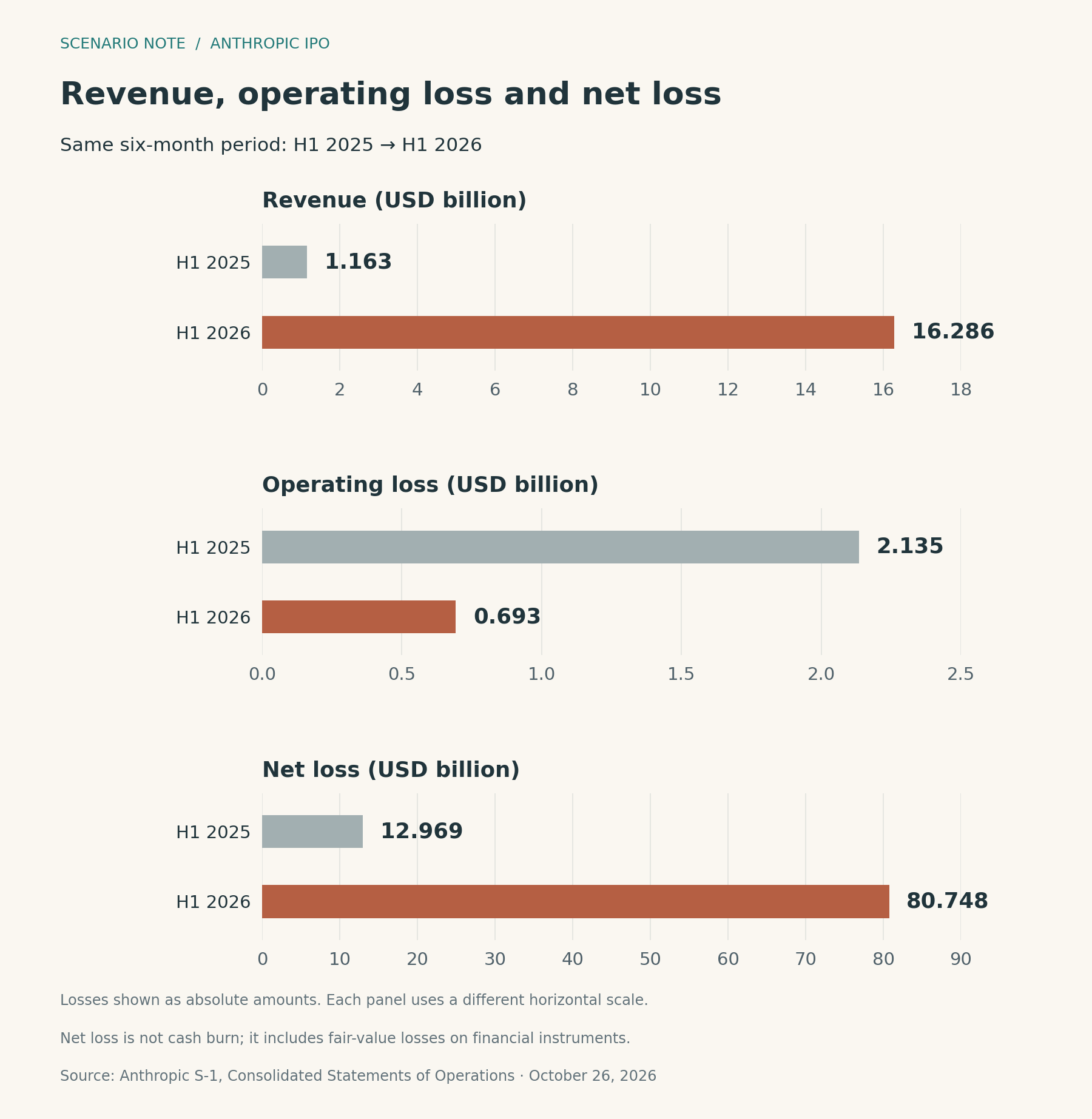
This is evidence that higher revenue is translating into improved operating performance. One profitable quarter, however, does not establish sustainable annual profitability. Revenue must continue to cover the training costs of future models, compute infrastructure and customer acquisition as those expenses evolve. Equally, focusing only on the first-half net loss would overlook the improvement in the underlying business.
Adjusted operating profit also needs to be distinguished from the GAAP result. The company reported first-half adjusted operating profit of $1.618 billion. It arrived at that figure by adding $2.185 billion in stock-based compensation and $126 million in noncash donation-related expenses to the $693 million GAAP operating loss. Excluding noncash expenses offers another view of operating performance, but it does not remove the economic cost of potential shareholder dilution from stock-based compensation. [1]
The $80.7 billion net loss was not an equivalent cash outflow
The first-half net loss was $80.748 billion. Nonoperating items explain much of the gap with the $693 million operating loss. Subtracting $1.111 billion of interest income from the operating loss, then adding $72.388 billion of fair-value losses on convertible instruments and related items, $8.757 billion of other net expense and $21 million of income tax expense reconciles to the net loss. Other net expense also includes financial-instrument valuation items. [1]
Convertible instruments can become shares under specified contractual terms. A right to receive shares at a previously agreed low price can become more valuable to its holder as the company’s valuation rises. Anthropic measures these convertible notes at fair value. When that value increases, the company records a larger liability and a valuation loss. Business growth and a widening accounting net loss can therefore occur together.
The timing of the accounting loss must be distinguished from the timing of a cash payment. Recording a valuation loss does not mean the same amount was repaid in cash during that six-month period. The economic burden still matters: conversion dilutes existing shareholders, while unconverted instruments may retain repayment obligations under their terms. Neither treating the entire net loss as cash burn nor dismissing the valuation loss provides a complete picture.
Operating cash flow improved, but the source of the cash balance matters
First-half operating cash flow moved from a $1.513 billion outflow a year earlier to a $3.929 billion inflow. That is a positive development alongside the improvement in operating results. The cash flow statement starts with net loss, adjusts for noncash items such as valuation losses, and reflects movements in receivables, customer advances and supplier-payment timing to arrive at operating cash flow. [1]
For example, cash received from customers in advance boosts cash inflows while leaving an obligation to provide services. An increase in amounts owed to suppliers can also leave more cash on hand temporarily. Conversely, revenue growth may precede cash collection. The question is whether positive operating cash flow persists, and how much it depends on the timing gap between receipts from customers and payments to suppliers.
At June 30, cash, cash equivalents and short-term investments totaled $131.651 billion. That total should not be read as cash accumulated entirely from the business. Net cash proceeds from preferred-stock issuance during the same six-month period were $110.432 billion. Cash generated by operations and cash raised from investors serve different purposes. Moving cash into short-term financial investments should also not be counted in full as operating cash burn, which would overstate the burden of running the business. [1]
The current cash position gives the company time. Whether the business can fund future infrastructure spending itself is a separate question. Operating cash flow needs to be considered alongside capital expenditure, lease payments, advance payments and other cash requirements.
Convertible-note liabilities, principal and future purchase commitments
Net loss is an accounting result over a period; liabilities are obligations measured at a point in time. The net loss cannot simply be relabeled as an outstanding debt balance. An accumulated deficit likewise reflects past accounting losses, rather than an equivalent sum owed to a bank. Anthropic’s fair-value accounting for convertible notes also creates a substantial difference between their carrying amount and their principal.
| Reported item | At June 30, 2026 | How to read it |
|---|---|---|
| Total liabilities | $117.467 billion | The balance-sheet total, including convertible notes, payables, lease liabilities and customer advances |
| Carrying amount of convertible notes | $108.566 billion | Measured at fair value; different from the principal borrowed |
| Principal of outstanding convertible notes | $6.203 billion | The principal of Amazon’s non-interest-bearing rollover convertible notes outstanding at that date |
| Future fixed or minimum purchase commitments | Approximately $265.6 billion | Service-purchase commitments over 1–20 years; distinct from debt immediately payable |
These items have different scopes and measurement bases and should not be added together as “total debt.” Total liabilities already include the carrying amount of the convertible notes, which reflects the value of their future share-conversion rights. Purchase commitments concern services to be received in the future, with different timing for performance and accounting recognition. [1]
Conversion into shares may reduce cash repayment requirements while diluting existing shareholders. Ownership caps and other conditions affect conversion, so it cannot be assumed that all instruments disappear at the IPO. Cash repayment terms, maturities, conversion prices and the resulting share count need to be examined separately. An available credit facility is also distinct from debt already drawn; the existence of a borrowing limit does not establish an outstanding loan balance.
The risk ahead: spending commitments made before demand is known
To assess the future cash burden, the key questions are what must be paid, when and in what amount. Anthropic enters into long-term contracts to secure compute capacity. Some require minimum payments even if actual usage falls short. Weaker-than-expected demand could therefore leave the company paying for underused capacity.
Securing capacity in advance can also allow the company to meet a sharp increase in demand. The same contract can support growth while creating risk. The annual payment schedule, cancellation rights, minimum usage or payment terms, and funding sources matter alongside the headline commitment total. Some contract amounts remain variable, so disclosed minimum commitments do not capture every possible future expense.
The revenue model is connected to that risk. About 80% of first-half revenue was usage-based and about 20% was subscription-based. More intensive use of AI in customers’ workflows can drive rapid revenue growth. Lower usage or a shift to cheaper models can change that trajectory. The timing mismatch between usage-sensitive revenue and multiyear payment obligations is central. [1]
The compute supply chain includes AWS Trainium, Google TPUs and Nvidia GPUs. The additional TPU capacity associated with the Google–Broadcom partnership is scheduled to come online from 2027. A headline infrastructure agreement therefore cannot automatically be treated as a chipmaker’s current-period revenue or Anthropic’s current-period expense. [4]
Anthropic’s valuation and revenue multiples: what does $1.5 trillion imply?
Even after recognizing the improvement in the business, the price still needs to be assessed. Dividing hypothetical valuations of $1.5 trillion and $2 trillion by disclosed revenue produces very different multiples depending on the period used. The table treats those valuations as equity values and calculates simple equity-value-to-revenue multiples. These are neither cash-and-debt-adjusted enterprise-value-to-sales multiples (EV/Sales) nor confirmed IPO prices.
| Revenue used for comparison | $1.5 trillion equity-value assumption | $2 trillion equity-value assumption |
|---|---|---|
| 2025 annual revenue: $4.585 billion | Approximately 327.2× | Approximately 436.2× |
| Twice first-half 2026 revenue: $32.572 billion | Approximately 46.1× | Approximately 61.4× |
Last year’s revenue does not fully reflect the recent pace of growth. Doubling first-half revenue, however, produces neither actual full-year 2026 revenue nor company guidance. Demand growth, pricing and seasonality can change the outcome. A quarterly revenue run rate annualized over a full year must likewise be distinguished from revenue already realized over an entire year.
The useful outcome of this exercise is an understanding of the assumptions embedded in the price, rather than a single fair-value estimate. Revenue may grow while the market assigns a lower valuation multiple, leaving stock returns below expectations. As a simple illustration, 40% revenue growth combined with a 30% decline in the revenue multiple produces a value equal to 98% of the starting value. This is an illustrative assumption, not an Anthropic forecast.
The final offering terms also require attention to the share count after conversion of convertible notes and preferred stock, the mix of newly issued and existing shares, the public float and lockups. The company’s proposed public-benefit-fund share allocation should be assessed alongside the final ownership structure. The value of the growing business and the economic share available to new investors require separate calculations. [5]
The macro backdrop affects both valuation and financing conditions
On October 28, U.S. time, the Federal Reserve held its target range at 3.75%–4.00%. Its statement described resilient economic activity and investment while noting that inflation remained elevated. An immediate improvement in financing conditions and equity valuations from lower interest rates cannot be taken for granted. [6]
September CPI rose 0.6% month over month and 3.7% year over year. Core CPI increased 0.3% and 2.6%, respectively. Nonfarm payrolls rose by 29,000 in the same month, and unemployment was 4.2%. A small monthly jobs gain alone does not establish a recession; subsequent inflation and employment data need to be considered together. [7] [8]
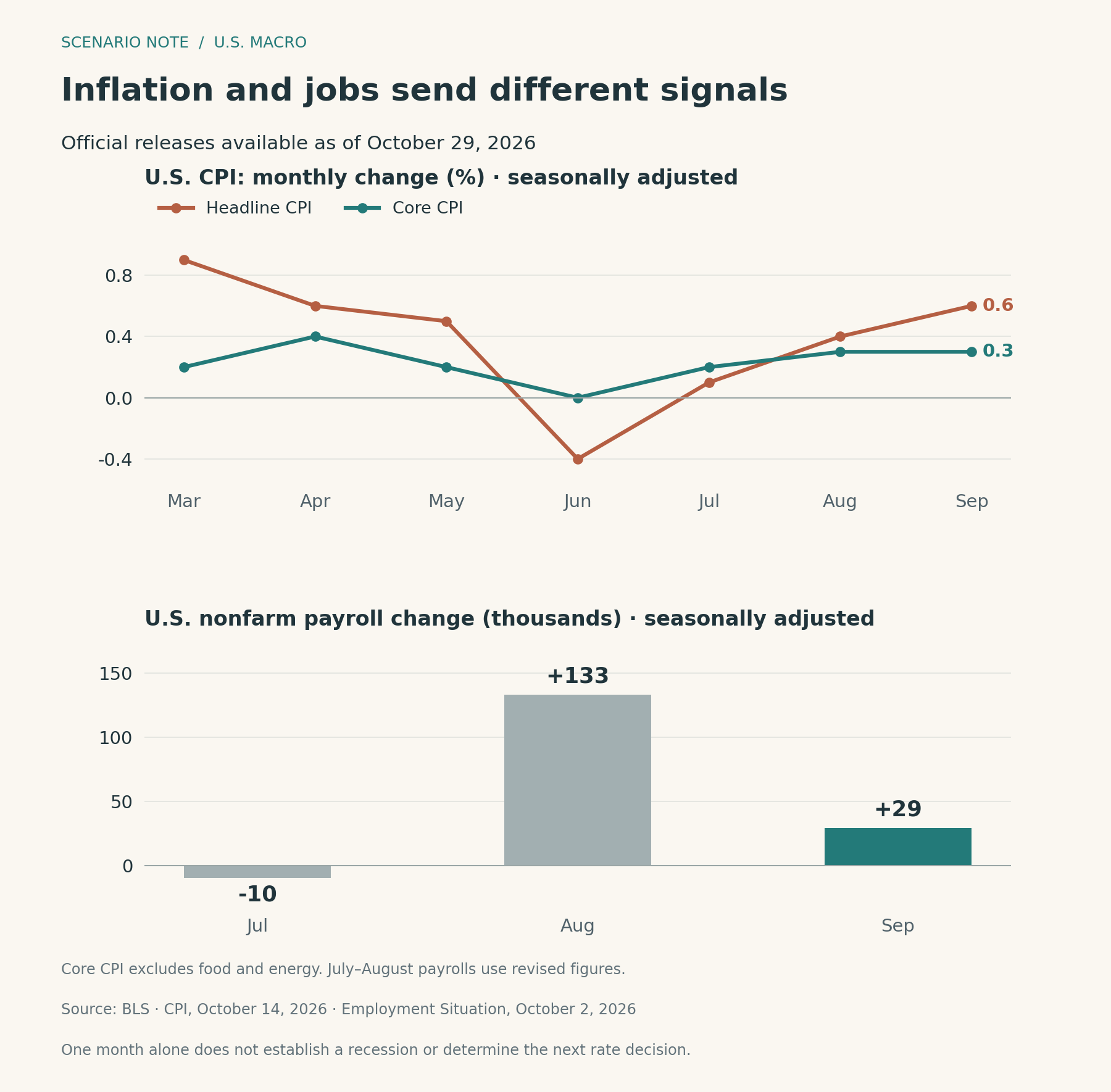
Easing inflation alongside resilient business spending could support AI demand and equity valuations. Prolonged high interest rates could lead investors to scrutinize both the price paid for future earnings and additional financing terms more closely. If rates fall because the economy weakens, a lower discount-rate burden may coexist with disappointing customer usage and AI budgets. Cost-saving AI adoption could also increase, making actual customer spending an important signal.
Existing non-interest-bearing convertible notes, interest on new borrowing and infrastructure financing by partners must be distinguished. Higher rates do not increase interest costs on every existing instrument in the same way. They can, however, affect the terms of new financing and the returns investors require. Investors measuring returns in another currency must also account for exchange rates; Korean investors, for example, are exposed to movements in the won-dollar rate.
Three possible scenarios and the signals that could change the assessment
The next assessment will become more concrete with final offering terms and subsequent quarterly results. Once the offering terms are available, the price and the share count after conversion and dilution can be checked first. Each new earnings release can then be used to assess the durability of profits and cash generation. The following are conditional scenarios based on the filings discussed above; more than one can occur together.
| Possible scenario | Signals to watch | Conditions that would change the assessment |
|---|---|---|
| Growth produces recurring profit and cash | Next-quarter GAAP operating results, operating cash flow, and movements in receivables, customer advances and supplier-payment timing | Continued revenue growth and operating profit, together with repeated improvement in cash generation after considering working-capital effects, would strengthen the case for business sustainability. |
| Results improve, but the valuation burden rises | Final offer price, share count after conversion and dilution, revenue multiples calculated on a consistent period, and interest-rate and inflation trends | If the offer price already assumes rapid growth while interest-rate pressure or other factors lower the multiple the market accepts, stronger results would need to be weighed against a more demanding entry valuation. |
| Demand slows while spending obligations remain | Usage-based revenue growth, annual purchase-commitment payment schedules, cash balances and additional financing terms | If operating cash inflows cannot cover required payments and reliance on additional funding increases, liquidity and the potential dilution of new shareholders would warrant closer scrutiny. |
The focus is the durability of improvement and the price paid for it
The filings show positive developments in revenue, quarterly operating profitability and operating cash flow. Much of the large net loss also reflects noncash valuation items. That explanation does not eliminate shareholder dilution or the future cash burden of long-term contracts.
Claude’s growth is the starting point. The investment case depends on whether growth becomes recurring profit and cash, how much of that value reaches new shareholders after dilution and future spending, and the price paid for that share. Revisiting these three questions when offering terms and subsequent results are published helps distinguish evidence that supports current expectations from signals that call for a change in view.
Key topics: Anthropic IPO · Anthropic stock market listing · Anthropic valuation · Anthropic financial results · net loss and operating loss · convertible-note liabilities · operating cash flow · revenue multiples
Sources and methodology
- SEC EDGAR — Anthropic, PBC Form S-1, October 26, 2026. Quarterly results, consolidated financial statements and cash flow statement, adjusted-profit reconciliation, and notes on convertible instruments and purchase commitments.
- Anthropic — S-1 filing announcement, October 26, 2026.
- Anthropic — Series H financing announcement, May 28, 2026.
- Anthropic — Google and Broadcom compute partnership, April 6, 2026.
- Anthropic — Public benefit fund proposal, October 18, 2026.
- Federal Reserve — October FOMC statement, October 28, 2026.
- BLS — September 2026 CPI, October 14, 2026.
- BLS — September 2026 Employment Situation, October 2, 2026.
This article distinguishes reported figures, interpretation and conditional scenarios. All monetary figures are in U.S. dollars, with units stated in the text. Multiples are the author’s calculations. Charts were prepared from public source data. This article provides general information and analysis and does not constitute a recommendation to buy or sell any financial instrument.